What Is Commercial Concrete Polishing and How Does the Process Work?
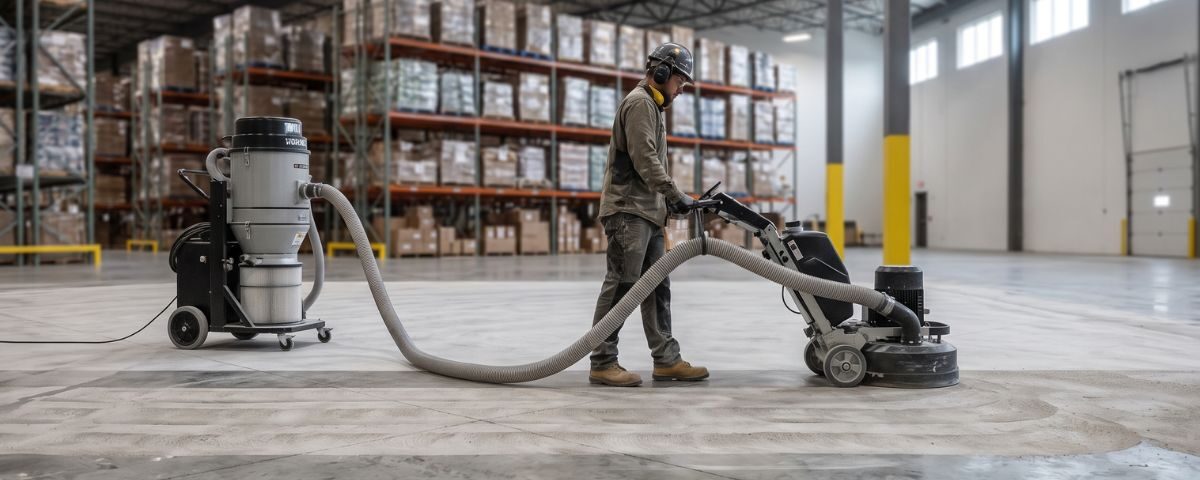
Commercial concrete floors often begin as structural slabs rather than finished surfaces. Over time, they may collect coatings, adhesives, stains, repairs, and wear from daily operations. Commercial concrete polishing uses mechanical equipment and progressively refined abrasives to turn a suitable slab into a finished floor with a specified appearance.
The commercial concrete polishing process is not simply the application of a shiny sealer. It typically involves evaluating the slab, preparing and repairing the surface, diamond grinding, densification when specified, honing, polishing, and applying a compatible protective treatment when included. The exact sequence depends on the concrete, existing materials, desired finish, and operational requirements.
This guide explains what commercial concrete polishing is, how the concrete grinding and polishing process works, and what you should consider before requesting concrete floor polishing services.
What Is Commercial Concrete Polishing?
Commercial concrete polishing is the process of mechanically changing a concrete surface to achieve a specified level of aggregate exposure and finished gloss.
The Concrete Polishing Council glossary defines bonded-abrasive polished concrete as a multistep operation that mechanically grinds, hones, and polishes the floor using progressively refined abrasives.
Unlike a film-forming coating, polished concrete uses the existing slab as the visible flooring surface. The work can expose different amounts of aggregate and produce finishes ranging from subdued to more reflective.
Natural variation, joints, repairs, and color differences may remain visible because they are part of the original concrete. For Indianapolis properties, commercial concrete polishing may be considered for warehouses, industrial facilities, commercial buildings, offices, and other spaces where the slab and project requirements are suitable.
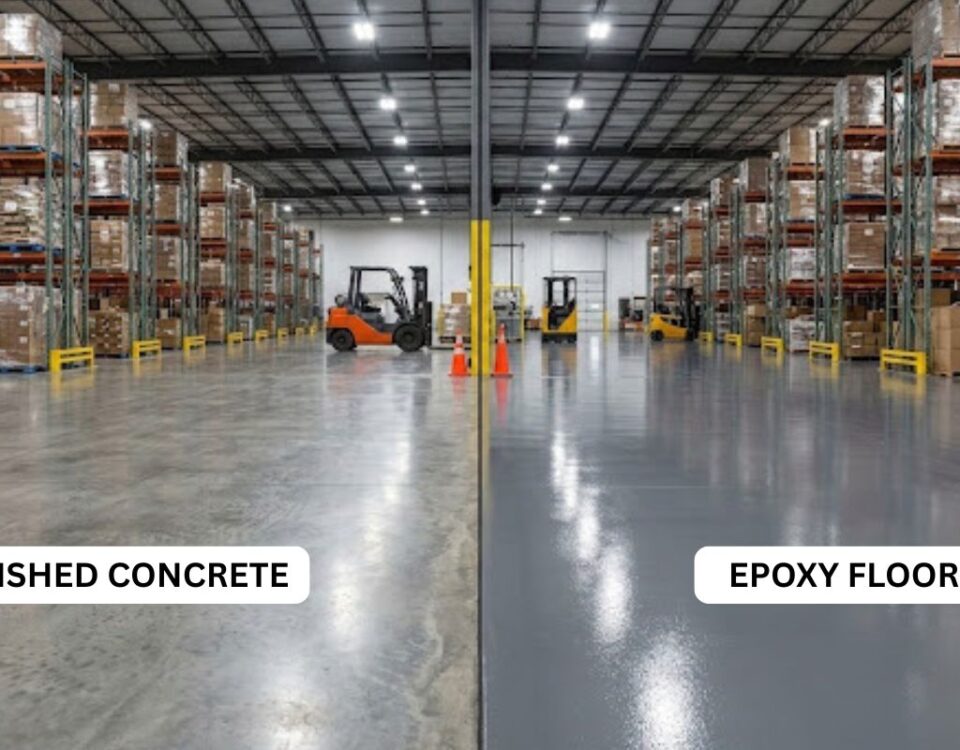
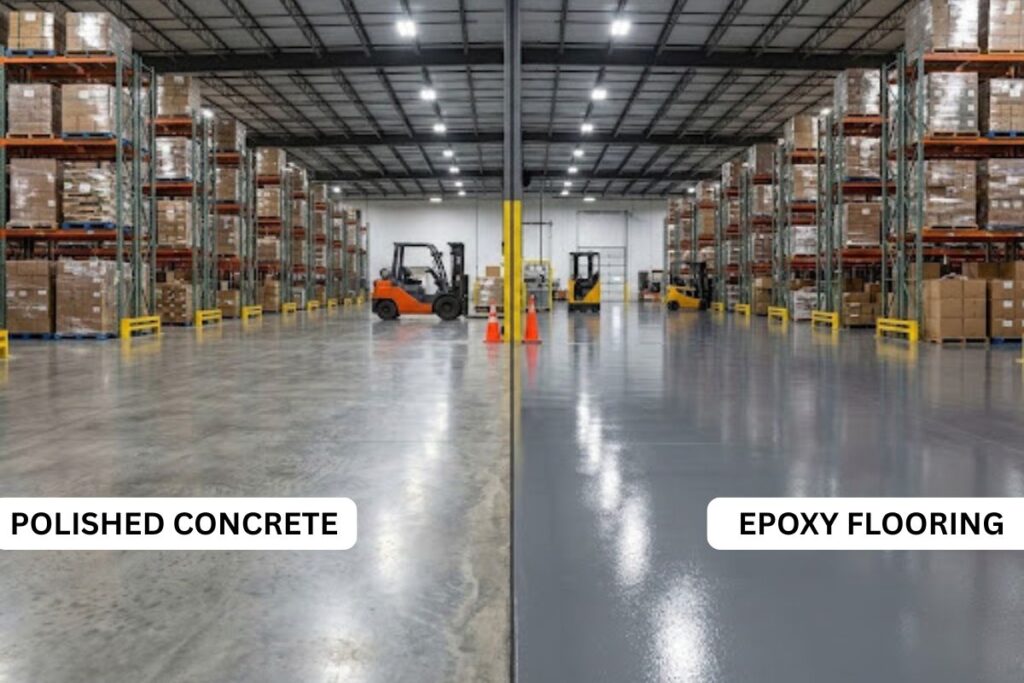
How Is Polished Concrete Different From a Floor Coating?
Polished concrete and resinous floor coatings are different systems.
Polishing mechanically refines the concrete itself. Epoxy, polyurea, urethane, and similar products create a film over prepared concrete.
A coating may be more appropriate where a project requires:
- Uniform color
- A continuous resinous surface
- Safety markings or designated work areas
- Decorative broadcast materials
- Product-specific chemical performance
A polished floor may be suitable when you want to retain the natural appearance of concrete and use the existing slab as the finished surface.
Because Fórte Surfaces provides both commercial polishing and industrial floor coatings, your facility can be evaluated before one system is selected. Available industrial systems include epoxy, polyurea, and urethane flooring systems.
Why Commercial Concrete Floor Preparation Comes First
The finished result depends heavily on the slab beneath it. Before grinding begins, the contractor should evaluate conditions that may affect appearance or performance.
Important considerations include:
- Existing coatings, adhesives, or mastics
- Oil, grease, and other contamination
- Cracks, joints, holes, and spalling
- Previous patches and repairs
- Surface hardness and porosity
- Flatness and elevation changes
- Desired aggregate exposure
- Desired sheen
- Traffic, equipment, and cleaning requirements
- Access, phasing, and operational restrictions
An existing slab does not become visually uniform simply because it is polished. Repairs, aggregate distribution, and variations created during the original concrete placement may remain visible.
A sample area or mockup may be useful when you want to establish appearance expectations before the full project proceeds. The Concrete Polishing Council describes a mockup as an on-site sample used to establish the expected appearance, procedures, and workmanship for a particular project.
How Does the Commercial Concrete Polishing Process Work?
The steps below describe a common bonded-abrasive process. The actual scope may change after the contractor evaluates the floor.
1. Site and Slab Assessment
The contractor reviews how the facility is used and inspects the concrete. This helps identify:
- Preparation requirements
- Existing materials
- Repair areas
- Contamination
- Finish expectations
- Access restrictions
- Operational concerns
If your property will remain occupied during the work, planning should also address work zones, equipment relocation, temporary traffic routes, and whether the project will be completed in phases.
2. Removal and Initial Surface Preparation
Existing coatings, adhesives, residues, and weak surface material may need to be removed before polishing begins.
Mechanical equipment is selected according to the material being removed and the condition of the concrete. Commercial concrete floor preparation is therefore not the same for every slab. A floor covered with adhesive requires a different starting approach from clean, newly placed concrete.
3. Crack, Joint and Surface Repairs
Selected cracks, holes, spalled areas, and other surface defects may be repaired before or during processing.
Repairs should use materials compatible with the polishing work and intended use of the floor. The Concrete Polishing Council states that repair materials should bond to the concrete and provide abrasion resistance appropriate for the surrounding polished surface.
Repairs may remain visible after polishing. Their purpose is to address specified defects—not necessarily to make an older slab appear identical to newly placed concrete.
Fórte Surfaces also provides concrete crack repair services when corrective work is included in the project scope.
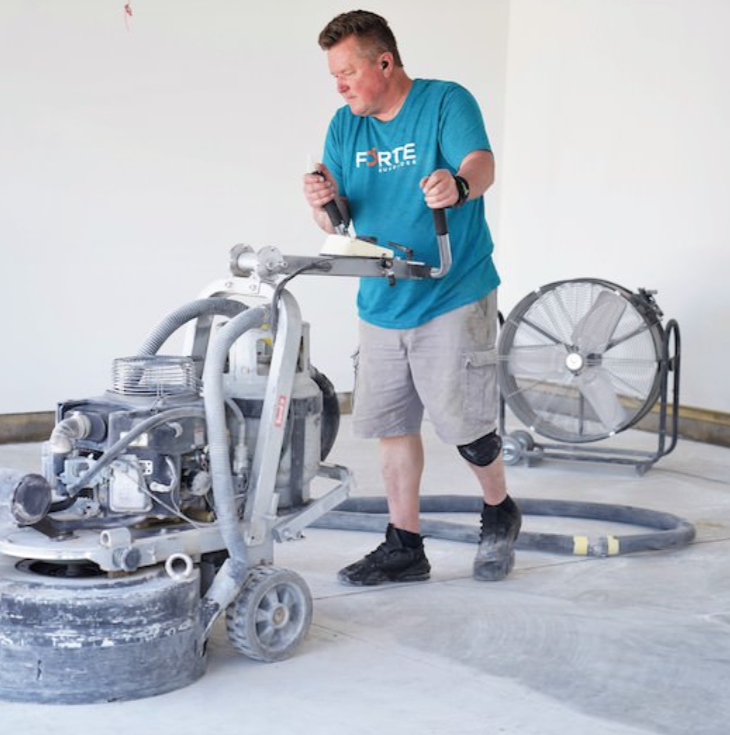
4. Diamond Grinding the Concrete Floor
Diamond grinding begins the mechanical refinement of the slab. Rotating grinder heads fitted with bonded diamond tooling remove and refine a controlled portion of the surface.
The starting tooling and number of passes depend on:
- Concrete hardness
- Surface condition
- Previous floor materials
- Desired aggregate exposure
- Equipment and tooling selection
Deeper grinding can reveal more aggregate, but the distribution and appearance of that aggregate are determined by the original concrete mix, placement, and finishing.
Diamond grinding concrete floors can generate respirable crystalline silica. OSHA’s guidance for walk-behind floor grinders identifies integrated wet methods and appropriate vacuum dust-collection systems as methods for controlling airborne dust.
5. Applying a Concrete Densifier When Specified
A concrete densifier for polished concrete is generally a silicate-based treatment that reacts within the concrete surface and helps harden or densify its cementitious wear surface.
It is not a thick floor coating and does not create the polished appearance by itself.
The product, application stage, and quantity depend on the slab and polishing specification. A densifier may be part of the system, but it should not be presented as a substitute for proper grinding, honing, and polishing.
6. Honing and Progressive Polishing
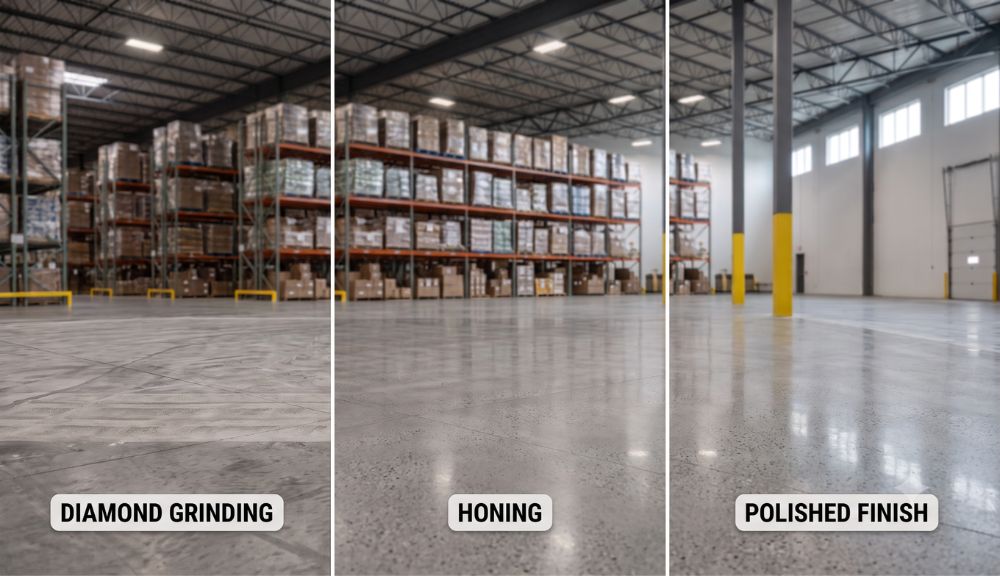
After the grinding stage, progressively finer diamond tooling refines the scratch pattern and develops the specified finish.
Honing prepares the concrete for the later polishing stages, while polishing continues the refinement until the required appearance is reached. Each stage should adequately refine the marks left by the previous stage.
The Concrete Polishing Council separates the work into grinding, honing, and polishing stages and defines diamond tooling as abrasive tools containing industrial diamonds within a bonded matrix.
7. Protective Treatment and Final Review
A compatible penetrating or semi-impregnating stain-protection product may be applied when included in the project specification.
This treatment is separate from the densifier. It should not be interpreted as making the floor resistant to every oil, acid, cleaner, or process chemical.
The contractor then:
- Reviews the completed floor
- Cleans the work area
- Confirms the agreed finish
- Explains initial protection requirements
- Provides maintenance guidance
- Establishes when each area can return to service
Understanding Polished Concrete Finish Levels
Two visual decisions strongly influence the appearance of commercial polished concrete.
Aggregate Exposure
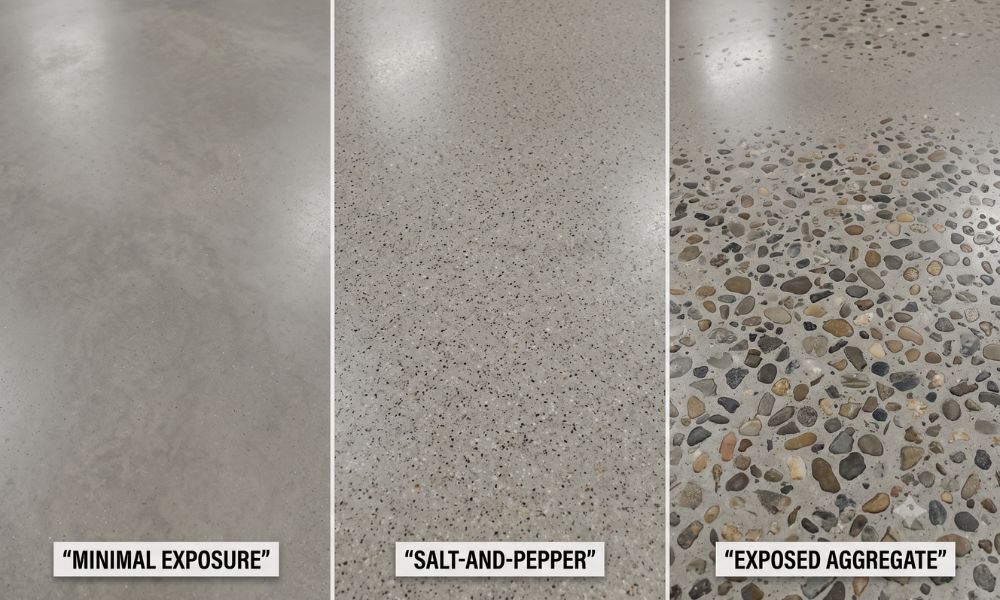
Aggregate exposure describes how much sand or stone becomes visible after grinding.
A lighter cut may retain more cement paste at the surface, while deeper grinding can expose fine or coarse aggregate. The contractor cannot manufacture aggregate that is not present within the slab. Its size, color, density, and distribution come from the original concrete mixture and placement.
The Concrete Polishing Council classifies aggregate exposure separately from finished gloss, which allows the amount of visible aggregate and the degree of sheen to be specified as different characteristics.
Finished Gloss
Finished gloss describes the degree to which the processed concrete has been refined.
The Concrete Polishing Council organizes polished concrete finish levels from flatter or honed appearances through more highly polished finishes. The finish you choose should be established before installation, ideally with a sample or mockup when visual consistency is important.
A higher sheen is not automatically the best choice for every facility. Lighting, maintenance expectations, contaminants, operational conditions, and desired appearance should guide your decision.
Where Can Commercial Polished Concrete Be Used?
Commercial polished concrete may be considered for:
- Warehouses and distribution facilities
- Industrial and light-manufacturing spaces
- Commercial construction and renovation projects
- Offices, lobbies, and corridors
- Retail spaces and showrooms
- Storage and back-of-house areas
- Selected institutional or healthcare common areas when project requirements permit
Fórte Surfaces provides commercial concrete polishing for warehouses, retail properties, offices, and other commercial spaces in Indianapolis.
Suitability should still be determined area by area. Chemical-handling rooms, processing zones, clinical spaces, or locations with specialized sanitation and containment requirements may need a resinous coating or another flooring system instead.
What Affects Project Schedule and Cost?
There is no reliable universal price or installation duration for commercial or industrial concrete polishing.
The project scope is influenced by:
- Total floor area
- Concrete condition and hardness
- Existing coating or adhesive removal
- Cracks, joints, and repairs
- Edge work and obstacles
- Aggregate-exposure requirements
- Specified finish level
- Protective treatments
- Work hours and building access
- Equipment relocation
- Project phasing
- Mockups, testing, or construction coordination
A site evaluation provides the best basis for a written proposal for your project.
When comparing proposals, look at the complete scope rather than only the headline price, because preparation, removal, repair allowances, edge work, and finish expectations can differ substantially.
Maintaining a Commercial Polished Concrete Floor
The maintenance plan should match the installed system and how the facility is used.
Routine care generally includes:
- Removing abrasive soil and debris
- Cleaning spills promptly
- Using products suitable for polished concrete
- Following the requirements of any protective treatment
- Monitoring heavily traveled areas
- Avoiding incompatible chemicals or cleaning methods
High-traffic lanes may eventually require mechanical maintenance or restoration. The Concrete Polishing Council publishes separate resources for the care and restoration of previously installed polished concrete floors.
The contractor should provide project-specific care guidance rather than relying on the assumption that polished concrete is maintenance-free.
Choosing Concrete Polishing Contractors in Indianapolis
When choosing a commercial contractor, look for one that clearly explains both the capabilities and limitations of the proposed system.
Before approving a project, ask about:
- Slab evaluation and preparation
- Coating or adhesive removal
- Crack and joint treatment
- Aggregate-exposure expectations
- Finish-level selection
- Dust-control procedures
- Mockups or sample areas
- Work-zone and phasing plans
- Maintenance requirements
- Written exclusions
- Return-to-service instructions
A project-specific evaluation can determine whether polishing, repair work, or a resinous flooring system is more appropriate for the facility.
At Fórte Surfaces, we offer concrete floor polishing services and related commercial surface services throughout Indianapolis and surrounding areas. Our services include current services also include concrete repair, industrial coatings, cleaning, sealing, and restoration.
Final Thoughts
The commercial concrete polishing process transforms a suitable slab through mechanical preparation, diamond grinding, densification when specified, honing, and progressive polishing.
It does not hide every repair or make every concrete floor look identical. Successful results depend on:
- Understanding the existing slab
- Selecting realistic aggregate-exposure expectations
- Specifying an appropriate finish
- Planning preparation and repairs
- Coordinating the work with facility operations
- Following a suitable maintenance program
If you’re considering commercial polished concrete for a warehouse, industrial facility, or commercial building, request a free estimate from Fórte Surfaces.
Frequently Asked Questions
Is commercial concrete polishing the same as applying a sealer?
No. Polishing mechanically refines the concrete using abrasives. A compatible stain-protection treatment may be applied afterward, but that treatment is not the polishing process itself.
Can every commercial concrete floor be polished?
Not every slab will produce the same result, and some may require substantial preparation or repair. Existing coatings, contamination, damage, hardness, aggregate distribution, and appearance expectations should be evaluated first.
What does a concrete densifier do?
A densifier reacts within the concrete surface to harden or densify its cementitious wear surface. It does not create the polished finish without the mechanical grinding, honing, and polishing stages.
How long does commercial concrete polishing take?
The schedule depends on the floor area, condition, removal work, repairs, desired aggregate exposure, finish level, access, and project phasing. A contractor should provide a project-specific schedule after evaluating the site.
Is polished concrete maintenance-free?
No. It requires routine soil removal, appropriate cleaning, and timely spill response. High-traffic areas may eventually require mechanical maintenance or restoration.