Flake vs. Quartz Floor Coatings: Which Is Better for Your Garage?
Choosing a garage floor coating involves more than selecting an attractive color. Homeowners also need to consider surface texture, daily vehicle use, cleaning requirements, and how well the flooring system suits their concrete.
When comparing flake vs quartz floor coatings, both options offer decorative finishes that can transform ordinary concrete into a more functional and visually appealing surface. However, they use different broadcast materials, creating distinct appearances and textures.
For Indianapolis homeowners, the decision may also involve exposure to winter moisture, road salt, and everyday garage activities. Understanding how each flooring system works can help homeowners make informed choices.
This guide compares flake and quartz coatings, including their appearance, durability considerations, installation, maintenance, and suitability for residential garages.
Understanding Flake and Quartz Floor Coatings
Flake and quartz flooring are decorative resinous coating systems applied over properly prepared concrete. While both can use epoxy as a base, their defining difference is the material broadcast into the coating.
What Are Flake Floor Coatings?
Flake flooring incorporates decorative chips, typically made from vinyl or similar polymer materials, into a wet resinous coating.
The flakes are available in different sizes, colors, and blends, allowing homeowners to customize the finished appearance. A compatible clear topcoat is generally applied to protect and encapsulate the decorative layer.
Fórte Surfaces provides decorative epoxy flake flooring for residential and commercial applications, including garages.
What Are Quartz Floor Coatings?
Quartz flooring uses colored mineral granules broadcast into a resinous coating system. These granules create a more granular appearance and can contribute to a textured surface.
Quartz systems may incorporate multiple broadcast layers depending on the design and performance requirements. A compatible topcoat completes the flooring system.
Fórte Surfaces also offers epoxy quartz coating systems for garages and other residential or commercial spaces.
Flake vs. Quartz Floor Coatings: Key Differences
Both finishes offer decorative versatility, but their materials and surface characteristics differ.
|
Feature |
Flake Coatings |
Quartz Coatings |
|
Decorative material |
Polymer flakes |
Colored mineral granules |
|
Appearance |
Multicolored, chip-like pattern |
Fine, granular appearance |
|
Texture |
Adjustable through broadcast and topcoat |
Adjustable, often more granular |
|
Customization |
Flake sizes and color blends |
Quartz colors and aggregate blends |
|
Durability |
Depends on the complete coating system |
Depends on the complete coating system |
|
Cleaning |
Depends on surface texture |
Depends on surface texture |
|
Common applications |
Garages and decorative concrete areas |
Garages and areas needing specified texture |
Neither material is automatically superior in every application. The complete coating system, substrate preparation, surface texture, and intended use determine suitability.
Appearance and Design Options
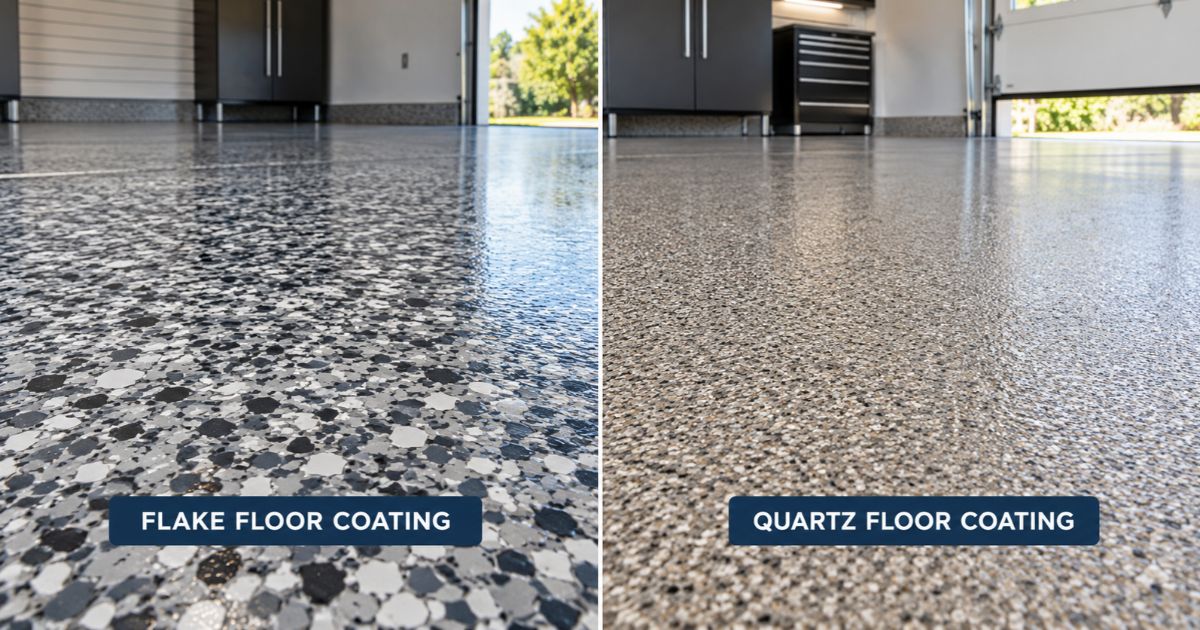
The visual difference between flake and quartz flooring is often one of the easiest characteristics to recognize. Flake coatings create a decorative, chip-like pattern, while quartz coatings provide a finer, mineral-based appearance.
Both options offer customizable colors and finishes, allowing homeowners to choose a style that complements their garage. Understanding these design differences can help determine which flooring option best suits their aesthetic preferences and practical needs.
Decorative Flake Flooring
Flake flooring produces a scattered chip pattern that can range from subtle to highly decorative.
Homeowners can select neutral combinations, contrasting blends, or finishes designed to complement garage walls, cabinets, and storage systems.
Larger flakes generally create a more noticeable pattern, while smaller chips produce a finer appearance.
The final result also depends on flake coverage, base-coat color, and the selected topcoat.
Decorative Quartz Flooring
Quartz flooring has a more consistently granular visual character. Colored mineral particles create a speckled appearance that can be customized through aggregate blends.
The mineral texture may suit homeowners who prefer a more uniform decorative pattern rather than larger visible chips.
Quartz also offers opportunities to customize surface texture based on the selected broadcast and coating design.
Neither finish has a universally better appearance. Homeowners should compare physical samples rather than relying entirely on online photographs.
Durability and Everyday Garage Performance
Residential garage floors experience vehicle traffic, stored equipment, occasional spills, and repeated cleaning.
Both flake and quartz systems can be designed for these conditions, but durability should not be judged solely by decorative aggregate.
Wear and Impact Considerations
A properly specified resinous system can provide a protective layer over concrete. Its resistance to abrasion and impact depends on coating thickness, resin formulation, aggregate, topcoat, and installation quality.
Quartz introduces hard mineral granules into the system, while flake coatings use decorative polymer chips.
However, this material difference alone does not prove one complete floor system will last longer than another.
Homeowners should ask which performance characteristics are documented for the proposed products.
Chemical and Stain Exposure
Garage floors may encounter oil, automotive fluids, cleaners, and road residues.
Resistance to these substances depends primarily on the specified coating and topcoat, including the chemical concentration and duration of exposure.
Neither flake nor quartz should be considered universally resistant to every automotive chemical.
Prompt spill cleanup remains important for both finishes.
Slip Resistance and Surface Texture
Floor traction is an important consideration when choosing garage flooring, especially where rainwater or melting snow may accumulate.
Quartz granules can contribute to surface texture, while flake systems can also be finished with textured topcoats or suitable traction additives.
However, aggregate selection alone does not establish that a floor meets a particular slip-resistance requirement.
The American Concrete Institute’s research on slip resistance explains how surface finish, texture, and protective treatments affect flooring traction.
Balancing Texture and Cleaning
More pronounced surface texture may improve traction under certain conditions, but it can also make dirt and residue harder to remove.
A smoother finish may be easier to wipe clean, although traction still needs consideration.
The appropriate balance depends on garage activities, expected moisture exposure, cleaning methods, and the finished system’s properties.
Homeowners should discuss these requirements before selecting either decorative coating.
Installation Process: Flake vs. Quartz Coatings
Flake and quartz systems share several installation principles, although the exact application methods differ. Both require proper concrete surface preparation, compatible coating materials, and careful application to achieve a suitable finish.
The main difference lies in how the decorative flakes or quartz granules are incorporated into the coating. Understanding these installation stages helps homeowners know what to expect during their garage flooring project.
Concrete Surface Preparation
Before either system is installed, the concrete must be evaluated for damage, contamination, moisture, and existing coatings.
Professional preparation may involve grinding or abrasive blasting to create the surface profile required by the selected resin system.
The American Concrete Institute’s guidance on resinous coating preparation identifies surface profile and preparation methods as important considerations for proper bonding.
Cracks, deteriorated concrete, and moisture-related concerns may also require attention before installation.
Decorative Broadcast and Topcoat
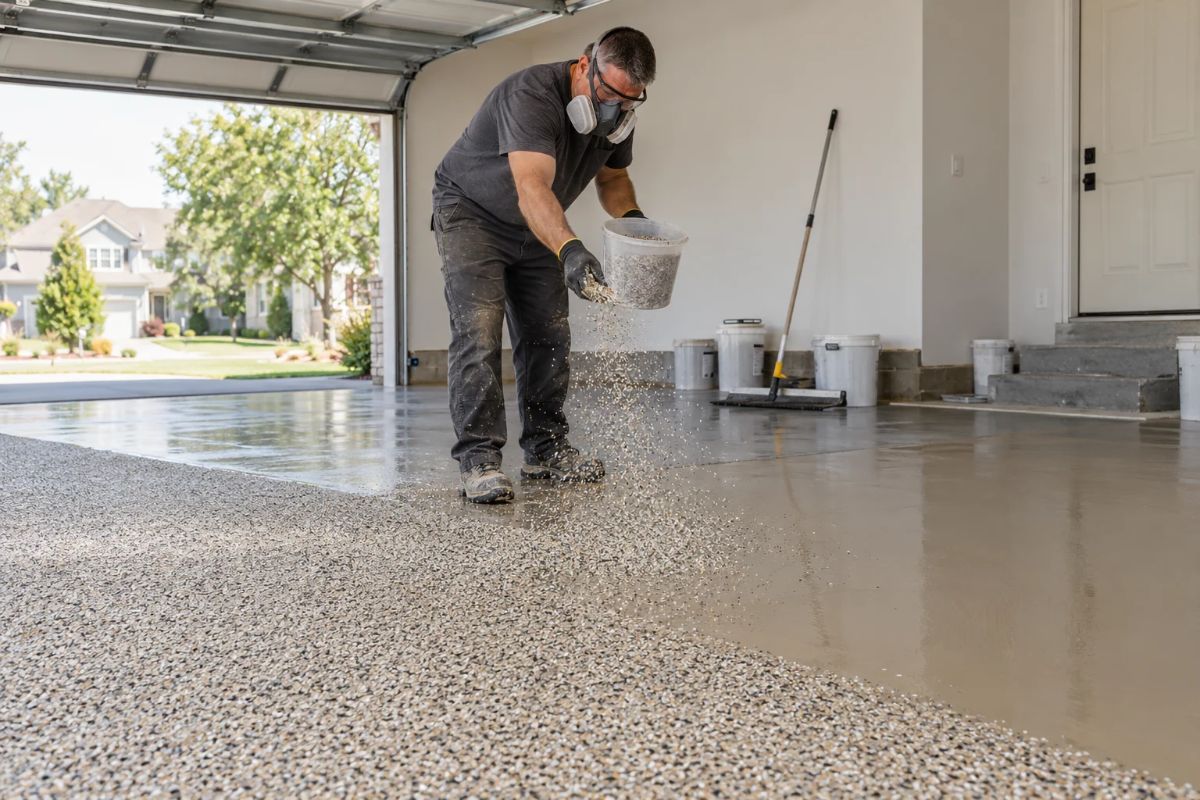
For flake flooring, decorative chips are distributed into the wet coating. Depending on the design, the broadcast may be partial or full coverage.
For quartz flooring, mineral granules are broadcast into the resin. Some systems use multiple layers to achieve the specified appearance and texture.
Excess broadcast material may be removed before applying the appropriate topcoat.
Curing and Return to Use
Both systems require sufficient curing before normal garage activities resume.
Installation and curing schedules depend on product chemistry, temperature, humidity, surface preparation, and project requirements.
Homeowners should follow the contractor’s specific instructions for foot traffic, vehicle parking, and cleaning rather than assume all decorative coatings cure at the same rate.
Maintenance and Long-Term Care
Both flake and quartz garage flooring require ongoing maintenance to preserve their appearance and protective properties. Regular cleaning helps remove dirt, debris, and residues that may contribute to surface wear over time.
Although both flooring options can be relatively easy to maintain, their cleaning requirements may differ depending on surface texture and the selected topcoat. Understanding these differences helps homeowners establish appropriate maintenance routines and protect their investment.
Cleaning Flake Flooring
Routine care generally involves removing loose dirt, cleaning spills promptly, and using cleaners approved for the installed coating.
Decorative flakes may help make minor surface debris less visually noticeable, but the floor still needs regular cleaning.
Avoid abrasive cleaning methods unless the coating manufacturer permits them.
Cleaning Quartz Flooring
Quartz floors benefit from similar maintenance practices. However, more textured finishes may retain dirt within surface irregularities.
Soft brushes, suitable cleaning solutions, and thorough rinsing may be helpful when permitted by the coating manufacturer.
For either system, cleaning methods should be selected according to the actual topcoat rather than the decorative aggregate alone.
Which Flooring Is Better for Your Garage?
The right choice depends on how the garage is used and which characteristics matter most to the homeowner. Both flake and quartz coatings offer decorative finishes, but their appearance, texture, and maintenance considerations can influence the decision.
Factors such as vehicle traffic, moisture exposure, cleaning preferences, and desired aesthetics should guide the selection. Comparing these features helps homeowners choose a flooring system that suits their garage’s practical needs and personal style.
When Flake Flooring May Be Suitable
Flake coatings are worth considering when homeowners prioritize:
-
A decorative chip-style appearance.
-
Flexible color and flake-size options.
-
A finish coordinated with garage storage or cabinetry.
-
A texture selected for ordinary residential use.
When Quartz Flooring May Be Suitable
Quartz coatings may be appropriate when homeowners prefer:
-
A finer mineral-based appearance.
-
A more granular decorative finish.
-
A system designed around particular texture requirements.
-
An aggregate-filled coating specified for the intended use.
These preferences are starting points, not fixed performance rankings.
Questions to Ask Before Choosing
Before making a final decision, consider the concrete’s condition, expected vehicle traffic, moisture exposure, cleaning preferences, and desired appearance.
Ask the contractor to explain the proposed coating layers, available finish samples, traction considerations, maintenance requirements, and warranty conditions.
Comparing complete system specifications provides more useful information than comparing decorative materials in isolation.
Choosing Professional Garage Floor Coatings in Indianapolis
Indiana homeowners should consider seasonal moisture, road salt, and changing temperatures when planning a garage flooring project.
Those conditions do not automatically favor flake or quartz. Instead, they reinforce the importance of suitable product selection, proper concrete preparation, and regular maintenance.
Fórte Surfaces provides both flake and quartz coating services in Indianapolis and surrounding communities. Homeowners can contact Fórte Surfaces to discuss available decorative finishes, project requirements, and suitable garage floor coating options.
Final Thoughts
The choice between flake vs quartz floor coatings depends on appearance, texture, maintenance preferences, and the garage’s practical requirements.
Flake systems provide customizable decorative chip patterns, while quartz systems offer mineral-based finishes with distinctive granular textures. Both can support a functional garage floor when properly specified and installed.
Neither option should be considered universally more durable or safer without evaluating the complete coating system.
Indianapolis homeowners planning a garage improvement can request a free estimate from Fórte Surfaces to discuss available coatings and select a finish suited to their space.
Frequently Asked Questions
Is quartz flooring stronger than flake flooring?
Not necessarily. Quartz uses hard mineral aggregate, but overall flooring strength and durability depend on the complete resinous system, coating thickness, preparation, and intended use.
Are flake garage floors slippery?
Traction depends on the finished surface texture, topcoat, contaminants, and conditions. Flake coatings can incorporate finishes designed to provide additional texture where appropriate.
Is quartz flooring harder to clean than flake flooring?
A heavily textured quartz finish may require more attention during cleaning. However, maintenance difficulty depends on the actual surface profile and topcoat, not simply the aggregate type.
Can both coatings be installed over existing concrete?
Yes, when the concrete meets the selected coating system’s requirements. Existing damage, contamination, moisture, and previous coatings must be evaluated before installation.
Which floor coating is better for an Indianapolis garage?
Either may be suitable. The best choice depends on the concrete’s condition, desired appearance, expected use, moisture exposure, and the selected coating system.