Polished Concrete vs. Epoxy for Warehouse Floors: Which Is Better?
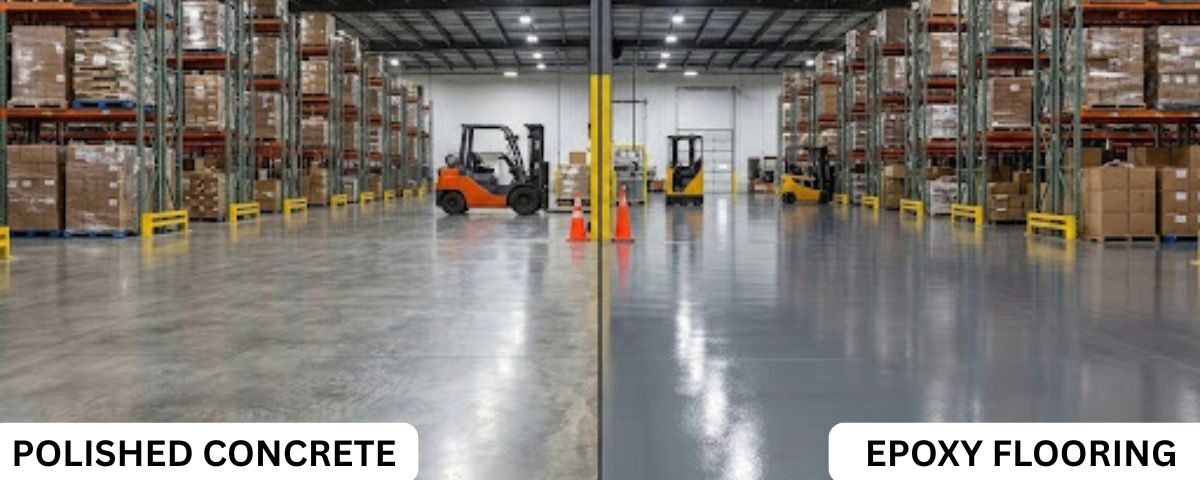
A warehouse floor may experience forklift and pallet-jack traffic, foot traffic, equipment movement, dropped materials, oil, cleaning products and other operational demands. Because those conditions differ between facilities, there is no single flooring material that is automatically best for every warehouse.
Two frequently considered options are polished concrete and commercial epoxy flooring. A polished concrete warehouse floor mechanically refines the existing concrete slab, while epoxy creates a resinous coating over properly prepared concrete.
Both systems can provide durable warehouse flooring when correctly specified, installed and maintained. The better choice for your facility may depend on factors such as appearance, chemical resistance, repair visibility, maintenance requirements and day-to-day operations.
This guide compares polished concrete vs epoxy for warehouse floors so facility managers, building owners and contractors can understand the key differences and determine which flooring system may be the better fit for their facility.
What Is a Polished Concrete Warehouse Floor?
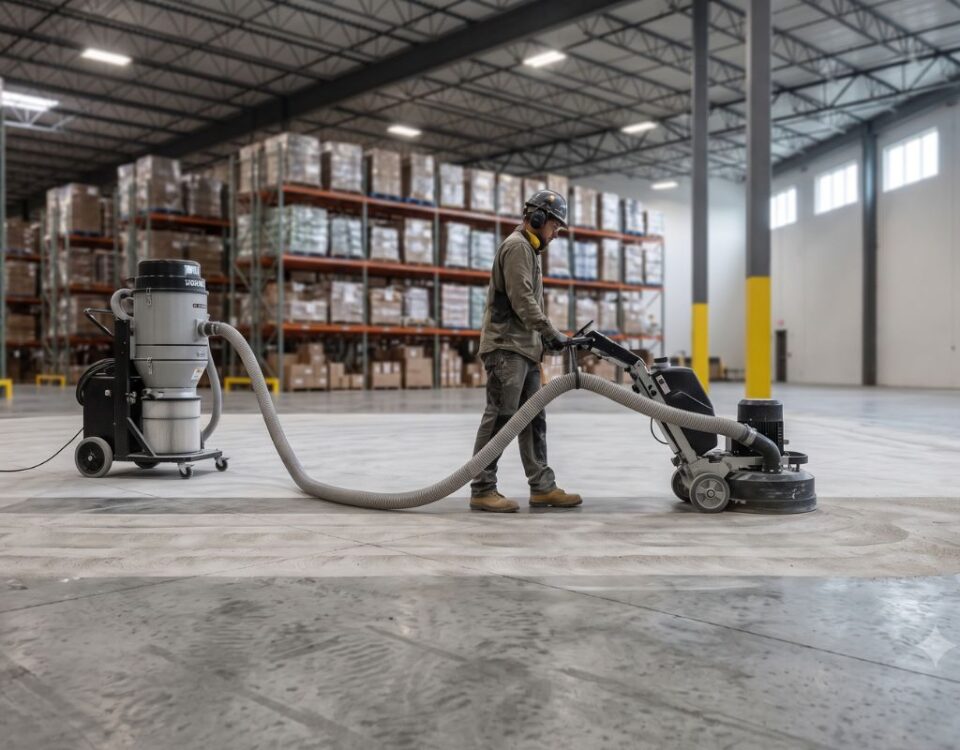
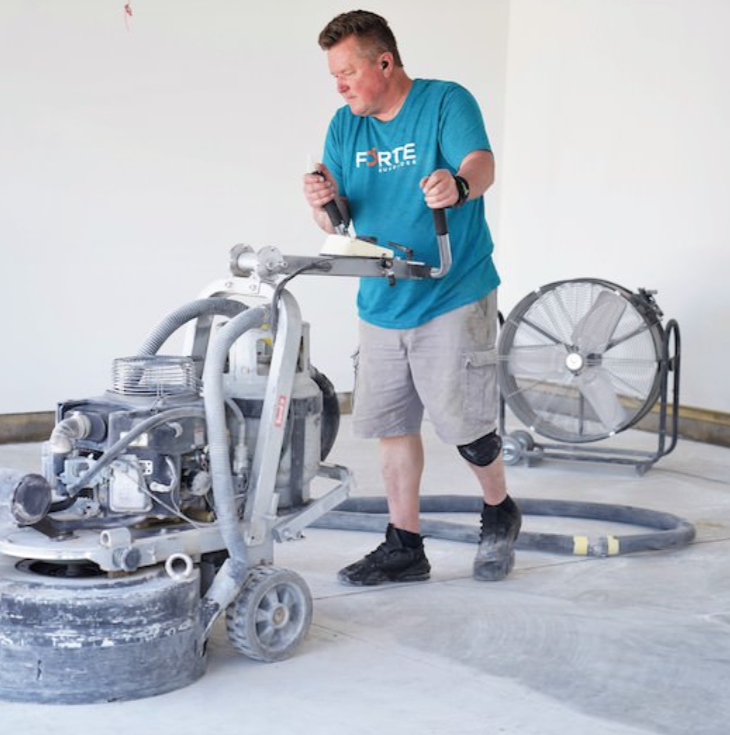
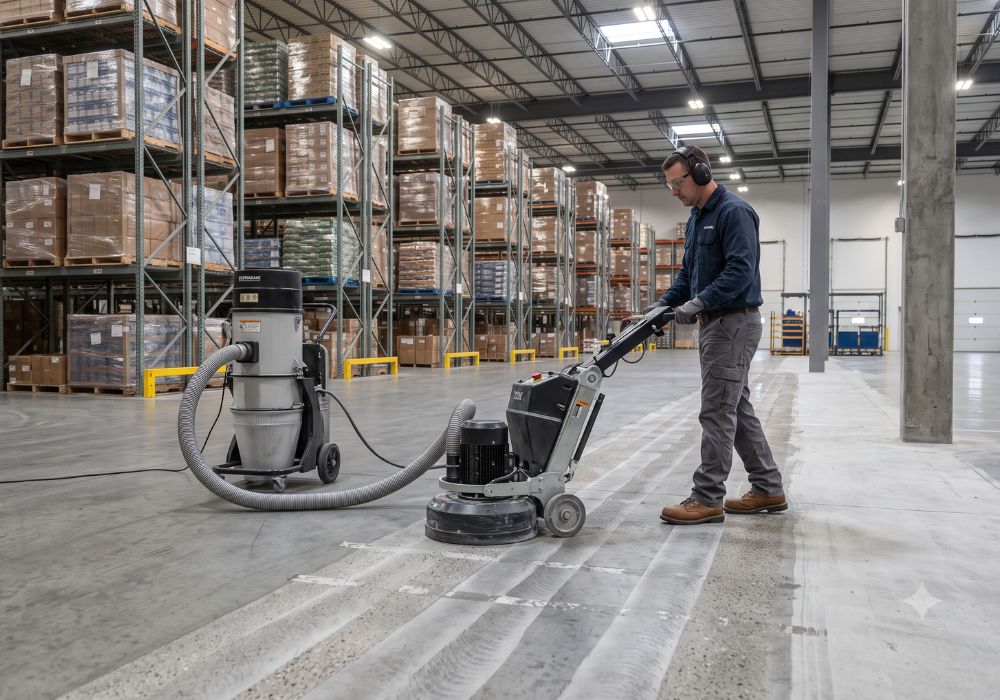
Polished concrete is produced by mechanically grinding, honing and polishing a concrete surface with progressively refined abrasives until the specified finish is achieved.
The Concrete Polishing Council defines bonded-abrasive polished concrete as a multistep process that cuts and progressively refines the concrete surface to reach a specified level of finished gloss.
A warehouse concrete polishing project may involve:
- Removing existing coatings or adhesives
- Evaluating cracks, joints and previous repairs
- Grinding the concrete
- Applying a densifier when specified
- Progressively refining the surface
- Polishing to the selected sheen level
- Applying a compatible stain-protection treatment when included
The appearance depends partly on the existing slab. Aggregate distribution, previous repairs, staining, surface hardness and concrete placement can all affect the completed floor.
A polished floor may show natural color variation, joints, patches and other characteristics of the original concrete. If you are comfortable with that appearance, commercial concrete polishing in Indianapolis may be a practical way to use a suitable existing slab as the finished flooring surface.
What Is Commercial Epoxy Flooring?
Epoxy flooring is a resinous system installed over mechanically prepared concrete. Its components chemically react and cure to form a film over the slab.
A commercial epoxy system may include:
- Concrete preparation
- Crack or surface repairs
- Primer
- Epoxy body coat
- Aggregate or decorative broadcast material
- Compatible protective topcoat
The number of layers, thickness, texture and topcoat depend on the selected system and facility requirements.
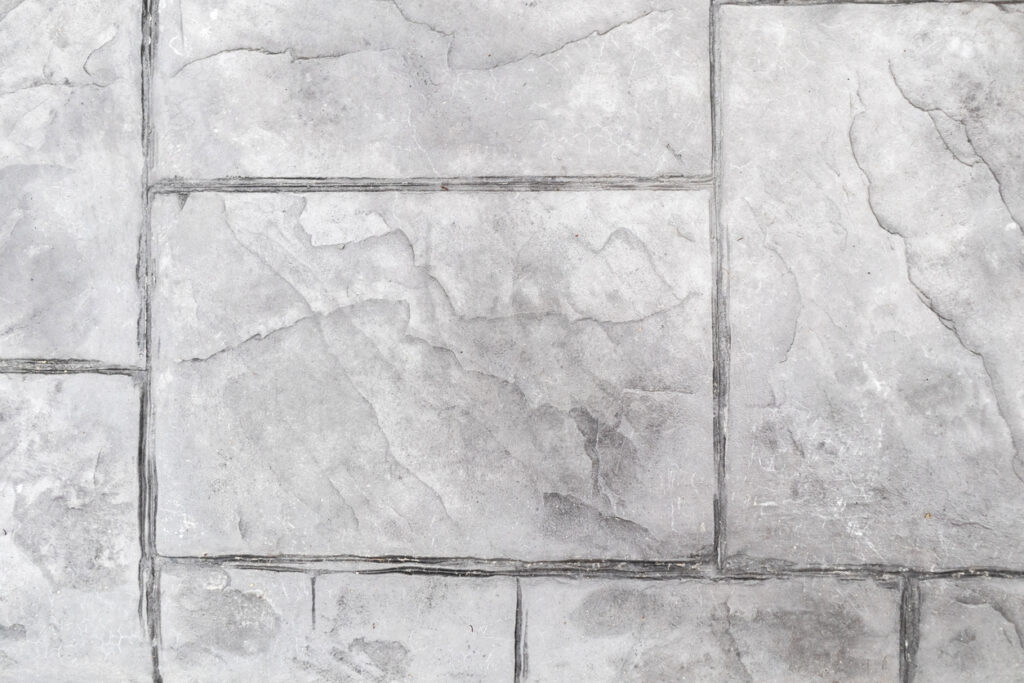
Unlike polished concrete, epoxy covers the surface of the slab. It can therefore provide a more uniform color and support finishes such as solid colors, flakes, quartz textures, safety markings and designated work zones.
Fórte Surfaces offers commercial epoxy flooring for warehouses and other commercial or industrial properties. Our industrial floor coatings service also includes epoxy, polyurea and polyaspartic systems.
Polished Concrete vs. Epoxy: Key Differences
The main difference is that polished concrete mechanically changes the existing concrete surface, whereas epoxy adds a separate resinous layer over the concrete.
| Consideration | Polished Concrete | Epoxy Flooring |
| System type | Refines the existing concrete slab | Covers prepared concrete with a resinous system |
| Appearance | Natural concrete with variable aggregate exposure | More uniform color and system-specific finish |
| Existing repairs | Patches, joints and variations may remain visible | May visually cover some variation, although defects still require evaluation |
| Chemical exposure | Depends on the concrete and specified protective treatment | Depends on the exact resin, topcoat, chemical and exposure conditions |
| Customization | Aggregate exposure, sheen and optional coloring | Colors, flakes, quartz, textures and safety markings |
| Maintenance | Requires a polished-concrete maintenance program | Requires compatible cleaning and monitoring for wear or damage |
| Return to use | Depends on preparation, repairs, polishing steps and treatments | Depends on preparation, number of coats and manufacturer-specified cure requirements |
| Typical consideration | Using a suitable existing slab as the finished floor | Creating a coated and more visually uniform surface |
Neither column should be interpreted as universally superior. The correct option depends on what the warehouse needs the floor to do.
Durability Under Warehouse Traffic
Forklifts, pallet jacks, carts and repeated foot traffic can place substantial stress on a warehouse floor. Dropped tools, pallets and equipment may also create impacts.
The performance of industrial polished concrete flooring depends heavily on the condition and quality of the original slab. Weak concrete, damaged joints, extensive cracking or unsuitable repairs can affect the finished result.
Before polishing, the contractor should evaluate:
- Concrete surface condition
- Cracks and joints
- Existing patches
- Previous coatings
- Oil or chemical contamination
- Traffic patterns
- Equipment and wheel types
- Desired aggregate exposure
Epoxy performance depends on similar substrate conditions as well as the specified coating system. A thin, light-duty coating should not be assumed to perform like a heavier, aggregate-filled resinous system.
For either option, surface preparation is a major part of the project. Existing damage may require concrete crack repair services before the final flooring system is installed.
Chemical, Oil and Stain Exposure
Chemical exposure can be a deciding factor in an epoxy vs polished concrete comparison.
Polished concrete is not a continuous resinous membrane. A densifier may help harden the concrete surface, while mechanical grinding and polishing refine it. A compatible stain protector may provide additional protection. However, the floor should not be assumed to resist every oil, acid, cleaner or process chemical.
Epoxy systems can be selected for particular chemical exposures, but “chemical-resistant” is not a universal rating. Performance varies according to:
- The exact coating and topcoat
- Type of chemical
- Concentration
- Temperature
- Duration of contact
- Frequency of exposure
- Spill-response procedures
A product may tolerate one substance but discolor, soften or lose gloss when exposed to another.
If your facility uses or stores chemicals, identify them and have your flooring contractor compare them with the coating manufacturer’s current technical information.
Maintenance and Cleaning Requirements
Both warehouse flooring options require maintenance.
For polished concrete, routine soil and grit removal is important because abrasive debris can affect the finish over time. Spills should be addressed promptly, and the maintenance team should use cleaning products and equipment suitable for polished concrete.
Depending on traffic and appearance expectations, the floor may eventually require mechanical maintenance or repolishing in selected areas.
Epoxy floors should also be swept or cleaned regularly. Facility staff should:
- Remove abrasive debris
- Clean spills according to site procedures
- Use products compatible with the installed coating
- Inspect joints and damaged areas
- Monitor heavily traveled lanes
- Avoid dragging sharp metal objects across the surface
A smooth epoxy surface may be easier to wipe than rough untreated concrete, but textured systems may require different cleaning equipment. The right balance between texture and cleanability should be discussed before installation.
Installation and Operational Downtime
There is no universal installation timeline for either system.
Warehouse concrete polishing can include several separate operations:
- Removing existing flooring materials
- Cleaning and evaluating the slab
- Completing selected repairs
- Grinding to the required depth
- Applying densifier when specified
- Progressively honing and polishing
- Applying a compatible protective treatment when included
The amount of work depends on the size and condition of the floor, desired aggregate exposure, edge work, repairs and number of polishing stages.
Commercial epoxy flooring requires surface preparation, application and curing. The return-to-service schedule varies by product, temperature, humidity, coating thickness, number of layers and intended traffic.
A floor may be ready for foot traffic before it is ready for forklifts, stored materials or full chemical exposure. The manufacturer’s written cure schedule should control when each type of traffic is permitted.
When planning the project, ask whether the work can be phased around your operations and how equipment, products and temporary traffic routes will be handled.
Polished Concrete vs. Epoxy Cost Factors
A meaningful polished concrete vs epoxy cost comparison cannot be made from a generic price per square foot alone.
Important cost factors include:
- Total square footage
- Concrete condition
- Existing coating or adhesive removal
- Oil and chemical contamination
- Crack and joint repairs
- Required aggregate exposure
- Desired sheen
- Epoxy system thickness
- Broadcast materials or topcoats
- Edge work and obstacles
- Safety markings
- Restricted working hours
- Equipment relocation
- Project phasing
- Site access
- Mockup or testing requirements
Polished concrete uses the existing slab as the finished floor, but extensive repair, removal or detailed edge work can increase the project scope.
Epoxy involves additional material and curing stages, but epoxy systems also vary substantially. A basic coating and a heavier industrial resinous system should not be treated as equivalent products.
The best comparison is based on written proposals that address the same floor area, operating conditions and performance requirements.
Safety and Slip-Resistance Considerations
A glossy floor should not automatically be described as slippery, and a textured floor should not automatically be considered safe in every condition.
Floor traction is affected by:
- Surface texture
- Water, oil or other contaminants
- Footwear
- Cleaning practices
- Wet or dry conditions
- Wear and surface damage
Epoxy systems can incorporate aggregate or textured finishes when additional traction is required. However, heavier texture may also make cleaning more difficult.
Polished-concrete traction should also be assessed based on the intended environment rather than appearance alone. Facility owners should identify any required test method or project specification before choosing a finish.
Polished-concrete traction should also be assessed based on the intended environment rather than appearance alone. Before choosing a finish, identify any required test method or project specification for your facility.
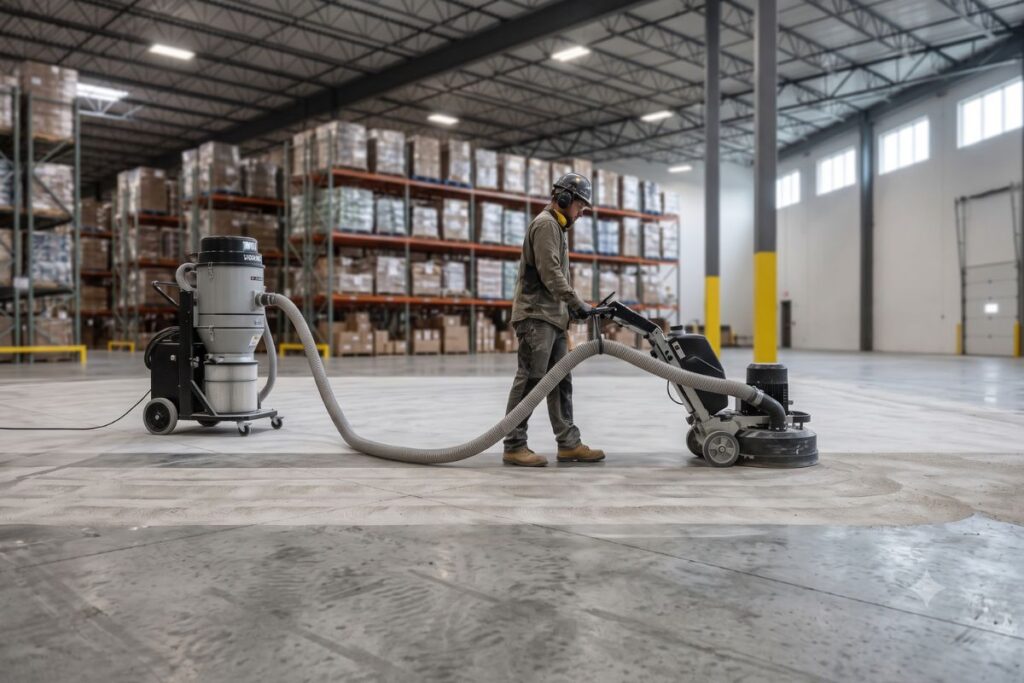
Concrete grinding can generate respirable crystalline silica. OSHA’s guidance for walk-behind floor grinders identifies integrated wet methods and appropriate vacuum dust-collection systems as methods for controlling airborne dust.
Which Warehouse Flooring Option Is Better?
A polished concrete warehouse floor may be suitable when:
- The existing slab is a good candidate for polishing.
- The facility wants to use the concrete as the finished floor.
- Natural slab and aggregate variation are acceptable.
- A continuous colored resin coating is not required.
- Chemical exposure is compatible with the specified finish.
- The maintenance team can follow a polished-concrete care plan.
Epoxy may be more suitable when:
- A uniform color or visual system is required.
- Safety markings or designated work areas are needed.
- The operation requires a coating selected for identified chemical exposure.
- A resinous surface is part of the project specification.
- The selected system is compatible with the slab and operating conditions.
Some facilities may use both. A general storage area could be evaluated for polishing, while maintenance, processing or chemical-handling areas are evaluated for epoxy or another specialty system.
Fórte Surfaces offers warehouse concrete floor coatings for industrial environments, along with concrete polishing for suitable slabs.
Choosing a Warehouse Flooring Contractor in Indianapolis
When choosing a warehouse flooring contractor in Indianapolis, look for a team that inspects your facility and asks detailed questions before recommending a system.
The assessment should address:
- Forklift and pallet-jack traffic
- Wheel materials and expected loads
- Chemical and oil exposure
- Current cleaning procedures
- Existing coatings or adhesives
- Concrete moisture and surface condition
- Cracks, joints and repairs
- Appearance expectations
- Required traction
- Project schedule
- Return-to-service needs
The proposal should clearly identify preparation, repair allowances, system materials, finish expectations, maintenance responsibilities and reopening requirements.
Because Fórte Surfaces provides both coating and polishing services, our team can compare the options for your facility rather than assuming that one system is appropriate for every warehouse.
Final Thoughts
There is no universal winner when comparing polished concrete vs epoxy for warehouse floors.
Polished concrete mechanically refines a suitable existing slab and preserves the natural appearance of the concrete. Epoxy creates a resinous surface that offers more uniform color and a wider range of system-specific finish options.
The best flooring for your warehouse depends on:
- Concrete condition
- Type of traffic
- Chemical exposure
- Maintenance capabilities
- Appearance goals
- Required texture
- Operational downtime
- Project budget
Before selecting a system, request a site evaluation and compare written scopes based on the same requirements for your facility.
To compare polishing, epoxy or other durable warehouse flooring options for your facility, request a free quote from Fórte Surfaces.
Frequently Asked Questions
Is polished concrete better than epoxy for forklifts?
Not automatically. Suitability depends on the concrete slab, forklift loads, wheel types, traffic patterns, joints and selected flooring system. Both options require a project-specific assessment.
Does polished concrete resist warehouse chemicals?
Resistance depends on the concrete, the chemical involved and any protective treatment applied. Polished concrete should not be assumed to resist every oil, acid, cleaner or process chemical.
Which flooring option requires less downtime?
There is no universal answer. Polishing time depends on preparation, repairs and the required finishing stages. Epoxy downtime depends on preparation, application and the manufacturer’s cure schedule.
Which warehouse flooring option costs less?
Cost depends on floor size, slab condition, repairs, coating removal, finish requirements, epoxy system build, access and project phasing. Comparable written scopes are needed for an accurate comparison.
Is polished concrete always slippery?
No. Traction depends on the surface, contaminants, cleaning practices, footwear and whether the floor is wet or dry. Slip-resistance requirements should be discussed during project planning.